
Operations at the Delhi airport remained normal. However, three flights were returned or diverted to the Delhi airport due to bad weather in Chandigarh, Varanasi and Lucknow on Tuesday night.
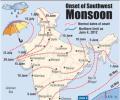
Southwest monsoon, the key to the agriculture driven trillion-dollar Indian economy, on Tuesday brought showers to Kerala bringing much-needed relief to farmers.

Flash floods triggered by a cloudburst in Mandi, Himachal Pradesh, resulted in casualties and widespread damage, prompting rescue operations and relief efforts.

The IMD projects total rainfall in the June-September monsoon season as being 99 per cent of the long-period average.
The state, which had been reeling under intense cold wave since a week, got some respite on Thursday as the minimum temperature rose to 4.4 degrees Celsius in capital city Patna while Gaya district recorded 3.4 degree Celsius.

The India Meteorological Department attributed the westerly wind and moisture incursion from the Arabian Sea as the reason behind the spell.

Villpuram district in north Tamil Nadu continued to reel under unprecedented flooding on Monday following extremely heavy rainfall, virtually blocking access to villages and residential colonies as bridges and roads overflowed, inundating huge acreage of standing crops and leaving passengers stranded as rail and road traffic was hit.

The Odisha government has asked all the district collectors to remain prepared for any eventuality, and directed the administration to evacuate people from low-lying areas in the event of heavy rain.

According to the IMD, a rain event is categorised as a cloudburst if a weather station receives 100 mm of rain in one hour.

Andhra Pradesh Chief Minister N Chandrababu Naidu and his Telangana counterpart Revanth Reddy visited some inundated areas in their respective territories.
The India Meteorological Department (IMD), for the first time, officially hinted at a drought-like situation, saying the southwest monsoon over India in 2012 is likely to be deficient at below 90 per cent of the Long Period Average (LPA).

Hundreds of people are being evacuated from coastal villages in Kutch district in view of cyclone Biparjoy, but authorities are facing a challenge as many villagers are reluctant to leave their livestock and belongings behind.

All sub-regions have been receiving good rainfall except the North-east and east region of the country, where the deficiency has reached 23 per cent.

The wholesale price index based inflation in June declined to 7.25 per cent from 7.55 per cent in the previous month.
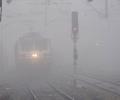
State capital Lucknow shuddered at 0.7 degrees Celsius, while Bahraich recorded a low of 0.2 degrees Celsius.

As the southwest monsoon continues to narrow its overall deficit, the India Meteorological Department (IMD) on Wednesday exuded confidence that the dreaded El Nino weather pattern was unlikely to affect monsoon rains this year.
Monsoon will hit the Kerala coast on June 1, setting the stage for the four-month annual rainfall season crucial for India's agriculture-based economy. "The date of onset of the southwest monsoon over Kerala is likely to be on June 1 with a model error of four days," the India Meteorological Department announced on Tuesday.
El Nino, an anomalous rise in sea surface temperature off the Peru coast, has been observed to often cause the Indian monsoon to flounder, resulting in poor rainfall. Nearly 60 per cent of agricultural land is wholly rain-dependent.

An improvement in the wind speed November 21 onwards might bring air pollution levels down.

The weather department has said that the skies are expected to be partly cloudy for the next few days in Delhi.
Commission for Agriculture Costs and Prices cairman Ashok Gulati tells Business Standard that IMD's prediction should be taken with a pinch of salt, as data shows there is usually a deviation of eight-10 per cent from the standard margin of error in many met predictions.

https://www.rediff.com/business/report/quality-control-orders-what-does-this-mean-for-domestic-industry/20240425.htm
A powerful earthquake of 7.4 magnitude struck southwestern Pakistan in the small hours of the day, tremors of which were felt in parts of northwestern India, including the national capital.

The administration is geared up for more showers as the India meteorological department has warned of heavy to very heavy rains with isolated extremely heavy rains in several districts of the state till Thursday morning.

After churning across the Arabian Sea for more than 10 days, Biparjoy made landfall near Jakhau Port in Gujarat on Thursday.

The Northern Railways said it has cancelled around 17 trains and diverted around 12 others, while traffic has been suspended at four locations due to waterlogging.
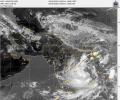
The maximum sustained wind speed is 55 knots gusting to 65 knots around system centre. Sea condition is rough to very rough, it stated.

The IMD issued a 'red alert' for Pune district and asked people to take precautions.

The weather system remained practically stationary during the last six hours and weakened to a depression, and is likely to turn into a well-marked low pressure area during the next 12 hours, it said in a bulletin.

Several parts of north and west India reeled under scorching heat wave with the temperature touching 50 degree Celsius in Rajasthan's Churu district on Tuesday, even as the meteorological department predicted very heavy rainfall in Assam and Meghalaya till May 28.
Drought looms as large this year as it did in 2009, even as attempts to play down its impact surface.

Although the monsoon is not active, it is not sluggish either he said, adding that the eastern coast, central India and north east are getting fairly good rains. Even Maharashtra and parts of peninsula are having rain.
Streets in localities like Hindmata, Dadar, Sion, King's Circle and Wadala are waterlogged. Suburban trains were running slow when reports last came in.

The crucial south-west monsoon is expected to bring its first showers to Kerala on June 3, a slight delay that could be attributed to the cyclone activity over the Bay of Bengal. "Southwest monsoon onset over Kerala is likely to be on June 3," said Chief Monsoon Forecaster, India Meteorological Department D Sivananda Pai.
The drought of 2009 still haunts the India Meteorological Department.

Of these four flights (except Qatar Airways) returned to Kozhikode airport as the weather condition in Kozhikode gained normalcy.
Senior officials of the India Meteorological Department said they were now more confident that El Nino would indeed appear during the second half of the southwest season, compared to April when the last official forecast was made.

Low temperature -- Delhi recorded a minimum of 13.5 degrees Celsius on Tuesday, the season's lowest so far -- allowed accumulation of pollutants, said Mahesh Palawat, vice president (meteorology and climate change), Skymet Weather.

The city's 24-hour Air Quality Index, recorded at 4 pm every day, stood at 418, up from 334 the previous day, and it may trigger stringent restrictions under the third stage of the graded response action plan to mitigate hazardous conditions.
The quake, with a magnitude of 5.9 on the Richter Scale, hit south Andaman region at 01:21 hours, the India Meteorological Department said in New Delhi.
